Amazon Go

Amazon_Go_food_shopper_exit_1.png

Amazon Go seen as welcome grocery option

But not all Americans would embrace cashier-free retail concept, survey says

Russell Redman 1 | Jul 02, 2018

Though Amazon.com Inc. is just getting under way with its Amazon Go stores, a new study finds that U.S. grocery shoppers are open to the cashierless retail concept.

Nearly 75% of 1,000 U.S. consumers polled by marketing firm Digital Third Coast for Schorr Packaging Corp. said they would be “extremely likely” or “very likely” to shop at an Amazon Go store if one opened nearby. What’s more, 84% of respondents indicated they would enjoy the Amazon Go customer experience more than conventional grocery shopping.

The checkout-free technology of the Amazon Go stores carries a lot of weight with consumers, the survey revealed. More than 25% of those polled said they would pay more for their groceries if they didn’t have to wait in line at the register.

Meanwhile, brands carry less weight: 32% of respondents said they would have less brand-specific preferences in an Amazon Go store.

“Amazon recently announced a futuristic take on the traditional grocery store, dubbed Amazon Go. It’s unknown how this will impact the brick-and-mortar retail industry, which is why we surveyed 1,000 Americans for their take on how Amazon Go will impact their lives, shopping habits and purchase decisions,” Aurora, Ill.-based Schorr Packaging stated in the study.

In January, Amazon opened the first Amazon Go store in Seattle. The e-tail giant confirmed that two more of the convenience-focused stores are planned for Chicago and San Francisco but hasn’t disclosed a timetable or details about the openings.

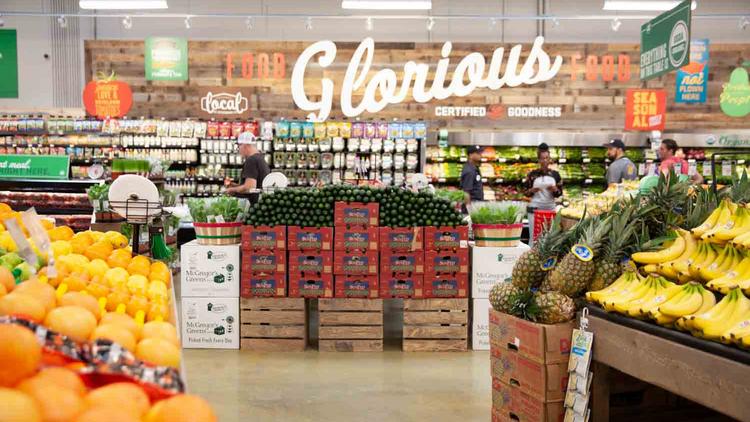
The 1,800-square-foot Amazon Go in Seattle carries primarily food and beverages, although nonfood items like batteries and over-the-counter medicine also are available. Food offerings include ready-to-eat breakfast, lunch, dinner and snack options made by the company’s chefs and local kitchens and bakeries.

The grocery mix ranges from essentials such as bread and milk to artisan cheeses and locally made chocolates. Also offered are chef-designed Amazon Meal Kits, which the company said enable consumers to make a meal for two in about 30 minutes.

Amazon’s “Just Walk Out” technology drives the Amazon Go store’s cashierless shopping experience. Overhead cameras, weight sensors and deep learning technology detect merchandise that shoppers take from or return to shelves and keep track of the items selected in a virtual cart. Shoppers use the Amazon Go mobile app to gain entry to the store through a turnstile. When customers leave the store, the Just Walk Out technology automatically debits their Amazon account for the items they take and then sends a receipt to the app.

The Schorr/Digital Third Coast survey found that this tech-heavy shopping experience doesn’t appeal to everyone, particularly older consumers. More than 30% of the Baby Boomers polled said they would be “somewhat likely” or “not likely” to shop at an Amazon Go store if one opened nearby. Also, 20% of respondents reported that they feel like they would be “losing out on something” by shopping at an Amazon Go store versus a traditional supermarket.

When consumers were asked to name the biggest drawback of shopping at Amazon Go compared with a conventional grocery store, 34% cited the lack of ability to use coupons. The next most-cited drawbacks were lack of product selection (29%), lack of social interaction (24%) and not being able to pay with cash (12.5%).

“Not everyone is on board — specifically, Boomers. They remain skeptical,” Schorr said. “While 75% of people surveyed said they would likely shop at an Amazon Go if one were located nearby, 30% of Baby Boomers said the opposite, that they would be unlikely to shop at Amazon Go even if it were conveniently located.”

The findings about Amazon Go reflected general preferences about grocery shopping uncovered in the study. Asked to rank the top factors influencing where they shop for groceries, respondents named freshness and quality, price, speed of shopping, availability of certain brands and location in order of importance.

In meeting their needs, 86% of consumers surveyed said they shop at one to two grocery stores in a single shopping trip. Brands didn’t have much sway, however, in determining where they shop for groceries.

“Presumably, people shop at multiple stores to make sure they get the goods and brands they prefer. But what’s interesting is what we uncovered in the survey: 75% of respondents said that, in theory, they would shop at a grocery store despite it not carrying their favorite brands,” Schorr noted. “In fact, only 13% of respondents said that it was extremely important to them for a grocery store to carry their favorite brands.”

Still, one in four of those polled said better-designed packaging would affect their purchasing decisions in an Amazon Go store. Other packaging-related factors that consumers said would influence their Amazon Go purchasing decisions would be discounts and promotions on the packaging (57%), clearer messaging (24%), unique design (17%), and larger logos and brand presence on the label (2%). Thirty-five percent of Boomers indicated they were more interested in product variety than packaging.

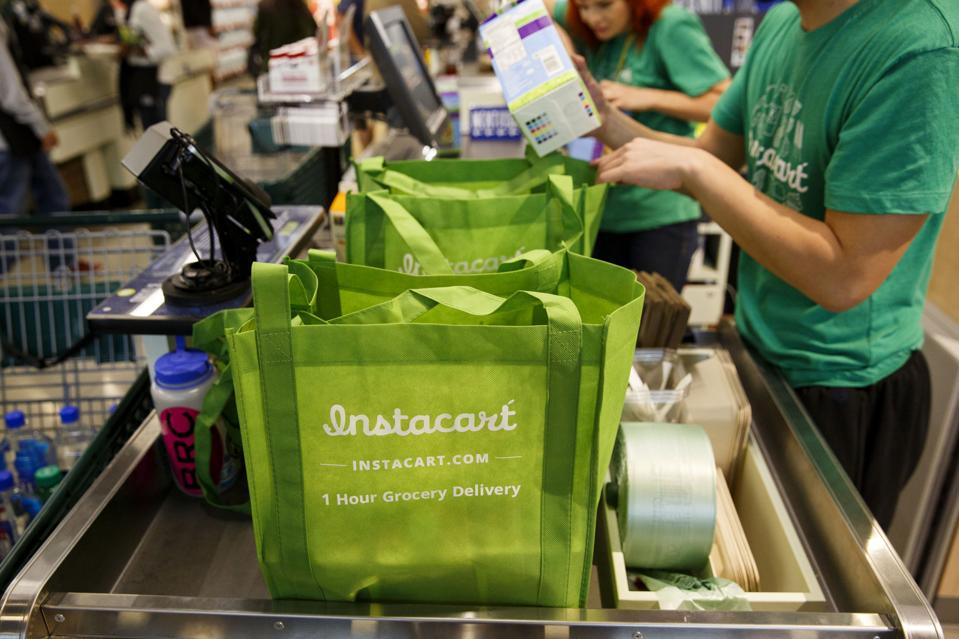
Trojan Horse: Instacart

The Trojan Horse: Will Instacart Become A Competitor Of The Grocery Retailers It Serves?

 
 Opinions expressed by Forbes Contributors are their own.

InstaCart employees fulfill orders for delivery to customers. Photographer: Patrick T. Fallon/Bloomberg

True story: Sam Walton, the founder of Walmart, is famous for using the phrase “steal shamelessly” when it came to keeping a close eye on competitors and applying the lessons learned to make Walmart a better company. Sam even wrote openly about stealing ideas in his 1993 autobiography Sam Walton: Made in America.

When Walmart was founded in 1962, its biggest competitor was Kmart. Being naturally curious and competitive, Sam made the decision that he was going to learn everything possible about how Kmart operated. Sam’s chosen method for learning? Go inside as many Kmart stores as possible to look around, and establish a relationship with executives from Kmart.

Sam Walton understood the importance of data to a retailer better than anyone. Data as it related to store operations, pricing, supply chain, technology, organizational structure, supplier relations, product assortment, promotions, consumer behavior and especially customer experience.

Walking into as many Kmart stores as he wanted and openly discussing retail with Kmart executives provided Sam with exactly the data he desired. Having unlimited access to Kmart allowed Sam to learn the two most important lessons about the company—its strengths and weaknesses.

And what did Sam do with the knowledge he gained? He modified Walmart’s business model to create a company that outperformed Kmart at every level, resulting in Kmart losing all relevance. Specific details on how Walmart grew can be found in the book Walmart: Key Insights and Practical Lessons from the World’s Largest Retail.

Sam Walton — the founder of Walmart and arguably the most influential and capable executive in the history of the retail industry.  (1985)(AP Photo)

The Trojan Horse 

Fast forward to 2018 and once again we are experiencing a repeat of the process utilized by Sam Walton to decimate Kmart. This time the company so deftly gaining access to retailer is Instacart, which recently announced it is expanding into another city.

Instacart requires a grocery retailer to provide them with certain data and access so Instacart can set up the grocery retailer within its core systems. Retailers invite Instacart inside their four walls and voluntarily provide them with data whereas Sam Walton had to often use his wits and charm to get the information he wanted. Kmart wasn’t concerned about Walton as it didn’t view him or Walmart as a threat.

Grocery retailers have embraced Instacart as few grocery executives believe Instacart will ever become a competitor. Kmart was wrong about Sam. Are grocery retailers wrong about Instacart? If so, Instacart is operating in a fashion like the famous Trojan Horse in Greek mythology as grocery retailers are enthusiastically inviting in an entity with the potential to become a major competitor.

I strongly advise the grocery industry to crush all assumptions that Instacart will look and operate the same way three to five years from now. In fact, the mantra I live by is Crush All Assumptions about business in general. Case in point: How many grocery executives thought Amazon would acquire Whole Foods? What prevents Instacart from changing its business model? Nothing.

Instacart will have no choice but to expand its business model to survive. Amazon is accelerating the expansion of Prime Now for grocery delivery and Target has accelerated the expansion of Shipt to deliver groceries and general merchandise.

Sooner rather than later, the grocery delivery and online order fulfillment services provided by Instacart will become a commodity business as more third-party delivery companies enter the market, and established third-party delivery companies expand.

Instacart attempting to add more services to current customers and signing up small regional grocery retailers to add scale is not a strategy that will insulate Instacart from disruption.

Kroger’s partnership with Ocado will allow Kroger to end or greatly scale back their relationship with Instacart and other third parties for grocery delivery. I anticipate that many grocery retailers will copy what Kroger is doing and this will impact Instacart.

CommonSense Robotics will become the go-to company for retailers looking for an automated solution to fulfill online grocery orders as well as meet demand for groceries in rural and urban areas. CommonSense Robotics can even build and operate sites capable of performing a dual role – fulfilling online grocery orders and building pallets to replenish groceries to retail stores.

Grocery retailers that want to replace Instacart can turn to Delivery Solutions, a Texas-based technology company that can help enable an intelligent, orchestrated mix of in-house and third-party delivery capabilities. Many grocery retailers have come to realize that owning the last mile and maintaining a direct relationship with its customers is more strategic than outsourcing last-mile deliveries. Delivery Solutions gives command and control of the customer experience back to the grocery retailer.

Instacart is under pressure due to the myriad of changes taking place in the grocery industry that are directly affecting the retailers served by Instacart. Instacart must adapt. Below are options Instacart could consider:

1. Get acquired. Google, Facebook, Microsoft, Walmart or Cerberus Capital Management, among others, could acquire Instacart and create a re-imagined experience for groceries. Cerberus owns the grocery retailer Albertsons and is in the process of attempting to acquire Rite Aid. If given the choice of acquiring Rite Aid or Instacart, Albertsons should acquire Instacart. I believe Instacart, Boxed Wholesale and Sprouts are vastly more strategic to Albertsons than Rite Aid.

2. Instacart can sign a strategic partnership with or acquire Boxed Wholesale or any number of grocery distribution and product manufacturing companies. If Instacart and Boxed team up, the combined companies could expand deeper into grocery retailing, B2B and B2C bulk sales and distribution, private label grocery and CPG manufacturing, wholesale grocery distribution, etc. (Full disclosure: I recommended to Kroger in 2017 to acquire Boxed Wholesale with final instructions to be prepared to bid as high as $600 million to acquire Boxed. With an estimated value of $470 million, Boxed turned down Kroger’s offer of $400 million.)

3. Instacart can sign a strategic agreement with or acquire CommonSense Robotics. A combined CommonSense Robotics and Instacart offers very interesting possibilities for the grocery industry.

4. If able to raise the required capital, which Instacart has proven it can do, Instacart could acquire the online retailer Peapod from Ahold Delhaize. Peapod has exceptional opportunities for innovation and growth whether owned by Instacart or Ahold Delhaize.

5. Leading CPG companies would be wise to consider acquiring Instacart and copying the Walmart model. Walmart acquired Jet.Com to gain access to technology and a team of executives under the leadership of Marc Lore, who could breathe new life into Walmart’s stagnant e-commerce business. It worked. Instacart’s executive team is like the one at Jet.Com—visionary, smart and capable—and they would add tremendous value to a CPG company looking for ways to ignite innovation and growth.

I believe Instacart has every intention of exploiting its technology and business prowess to the fullest to grow and remain relevant. It is entirely plausible that Instacart, under the right circumstances, could open innovative Instacart-branded stores—especially if Albertsons acquires Instacart.

I’m not attempting to predict what Instacart will do, I am merely pointing out the fact that Instacart has options they can pursue to change and expand its business model.

The Ghost of Sam Walton

Aldi, Sam’s Club, Costco, Kroger, Whole Foods, Ahold Delhaize, Publix, Supervalu, Wegmans and Albertsons are all customers of Instacart. The retailers I listed just happen to be the leading grocery retailers in the United States and in the case of Aldi and Ahold Delhaize, global grocery leaders. Instacart serves over 200 grocery partners in the U.S. and Canada. Should the executives at these retailers consider the possibility that Instacart could become a competitor? Yes, they should and here’s why:

  • Instacart is analyzing and learning how the retailers it serves operate across every aspect of grocery retailing. Or, stated another way, grocery retailers are teaching Instacart their business models.
  • Instacart is learning everything possible about the consumer behavior of the customers at each grocery retailer that has a contract with Instacart.
  • Instacart is thoroughly identifying the strengths and weaknesses of each grocery retailer they serve.
  • Instacart is the leveraging data it has collected to perform long-term strategic planning and “What If?” analysis to identify the optimal future state grocery-store format, technology, operating model, pricing, assortment and supply chain to delight customers across the grocery industry.
  • Instacart’s highly-skilled executive team isn’t satisfied with the status quo and the team will modify the business model to position Instacart for growth and relevance—this means applying the lessons they’ve learned from the grocery companies they serve to their advantage.

My advice to grocery executives who don’t believe Instacart may one day become a competitor is to learn from the past. Kmart executives used to sit and drink coffee with Sam Walton, someone they viewed as nothing more than a folksy CEO of a small company named Walmart who wanted to learn everything possible about how Kmart operated as a company. Walmart went on to become Kmart’s most formidable competitor by applying the lessons Sam learned from Kmart and other retailers. The ghost of Sam Walton lives on.

Brittain Ladd is a globally recognized thought leader on strategy, M&A, and the digital supply chain.